
Charge controllers for Siemens solar modules
The controller has to match two things: the string’s cold-weather voltage and the battery’s charging voltage. Here is how to choose between PWM and MPPT, and how to size either.
Key takeaways
- A 36-cell module (Vmp near 17 V) is the natural partner of a 12 V PWM controller; 30-cell modules fall below the absorption voltage when hot.
- The controller’s input rating must exceed the string’s Voc at your coldest temperature (four SM55 reach about 101 V at −20 °C).
- Size the controller current at least 1.25 × array Isc.
- Use MPPT for high-voltage strings, cold climates and long cable runs; a PWM controller wastes voltage above the battery’s.
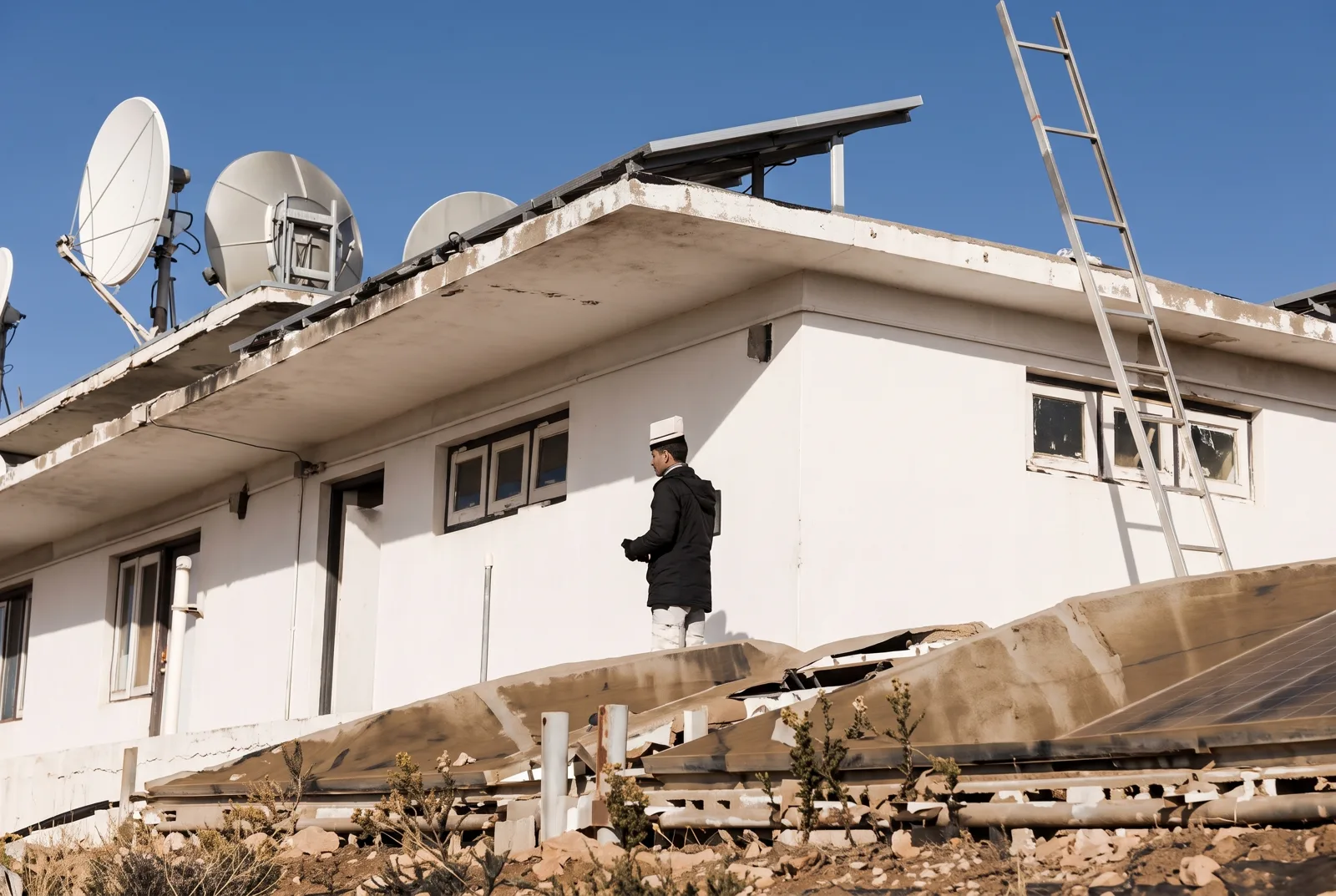
Siemens’ page on solar regulators says only that two models were available, ‘details to follow’. The installation notes name what its systems used: Siemens Showa Solar SPS-series regulators in Nepal, Solartec controllers on the Argentine repeater and a 12 A controller in the Wyoming camper. The principles have not changed. Here is how they apply to the 16 Siemens modules.
Why 36 cells suit a 12 V battery
A 12 V lead-acid battery needs roughly 14.4 V to absorb a full charge. Cell voltage falls as modules warm. The datasheet gives a Voc coefficient of −0.34 % per degree but no Vmp coefficient, so we show a range: with 60 °C cells an SM55’s Vmp of 17.4 V falls to somewhere between about 14.5 V (a typical −0.47 %/K) and 15.2 V (the Voc coefficient scaled), against the 14.4 V target. A 30-cell module such as the SM20 (Vmp 14.5 V) or SM46 (14.6 V) falls to roughly 12.1 to 12.9 V, well below it. That is why the model pages have a charging-headroom row, and why 36-cell modules are the usual choice for battery charging.
PWM or MPPT?
| PWM | MPPT | |
|---|---|---|
| How it works | Connects the array to the battery and pulses to hold the set voltage | Converts higher array voltage into more battery current |
| Best with | 36-cell 12 V modules on a 12 V battery, one module per battery voltage step | Strings with Vmp well above battery voltage, cold climates, long cable runs |
| Cost | Low | Higher |
| Watch out for | Wastes voltage above the battery’s | Maximum input voltage: the cold Voc of the whole string must stay below it |
Sizing a controller step by step
- Pick the module on the calculator and enter your string.
- Voltage: the controller’s maximum input must exceed the string’s Voc at your coldest cell temperature (for four SM55 in series, 4 × 25.2 V = 100.8 V at −20 °C).
- Current: 1.25 × array Isc is the usual minimum. Four SM55 in parallel have Isc 13.8 A, so a 20 A controller.
- Battery profile: match it to the battery, lead-acid or LiFePO4. Lithium batteries typically want 14.2 to 14.6 V absorption on a 12 V system and no equalisation.
Which controller for which system?
| Your system | Sensible choice | Why |
|---|---|---|
| One or two SM55, SP75 or SR50 on a 12 V battery, mild climate | A PWM controller rated above 1.25 × Isc | 36 cells, Vmp near 17 V: the module matches the battery |
| Four or more modules in series for 24 or 48 V | MPPT with an input rating well above the cold Voc | High string voltage; the controller does the conversion |
| 30-cell modules (SM20, SM46) or ST thin-film on a 12 V lead-acid battery | MPPT, or accept an undercharged battery on hot days | Vmp falls below the absorption voltage when cells are hot |
| Cold climate, long cable run | MPPT | Cold Voc is high and the extra voltage is usable |
Two examples
- The Startruck camper had two modules and a 12 A controller on 2 × 290 Ah batteries; its note recorded charging currents of 5 and 7 A in autumn.
- The marine note used an 8 A controller with a single 42 W module charging two 100 Ah batteries on a 20-day crossing.
The source gives only the ampere ratings of those controllers, not their type. See the RV and marine case files.
Questions readers ask
Can I use a PWM controller with a modern 60-cell panel?
No. A 60-cell panel has a Vmp near 31 V; a PWM controller would pull it down to the battery voltage and waste more than half of its power. Use MPPT.
What current rating do I need for two SM55 in parallel?
Isc is 2 × 3.45 = 6.9 A, so 1.25 × 6.9 = 8.6 A: a 10 A controller is enough.
Does a lithium battery change the controller?
It changes the settings. You need a lithium profile or manual setpoints (typically 14.2 to 14.6 V absorption on 12 V), no equalisation and a low-temperature charge cutoff.
Why does my battery never reach full charge in summer?
On hot days the module’s Vmp falls and may sit below the absorption voltage. Check the headroom row on your model’s page and consider an MPPT controller or an extra module in series.
Do I need a controller at all with a very small module?
A module delivering less than about 1 % of the battery’s amp-hour capacity as current (a few watts on a large battery) is sometimes run without one. For anything larger, use a controller to prevent overcharge.
Related guides
Wiring Siemens solar modules: series, parallel and bypass diodes
Wiring rules from the Siemens datasheets: maximum system voltage by model, series and parallel strings, cold-weather Voc, 6 V versions and bypass diodes.
Read more →Batteries for a 12 V Siemens solar system
Which battery to pair with Siemens modules: lead-acid versus LiFePO4, how to size from the daily load, worked examples and what the installation notes recorded.
Read more →Siemens solar array calculator
Calculator for Siemens SM, SP, SR and ST modules: cold-weather Voc, controller current, charging headroom for 12/24/48 V batteries and battery size.
Read more →The calculator returns the input voltage and current to ask for.