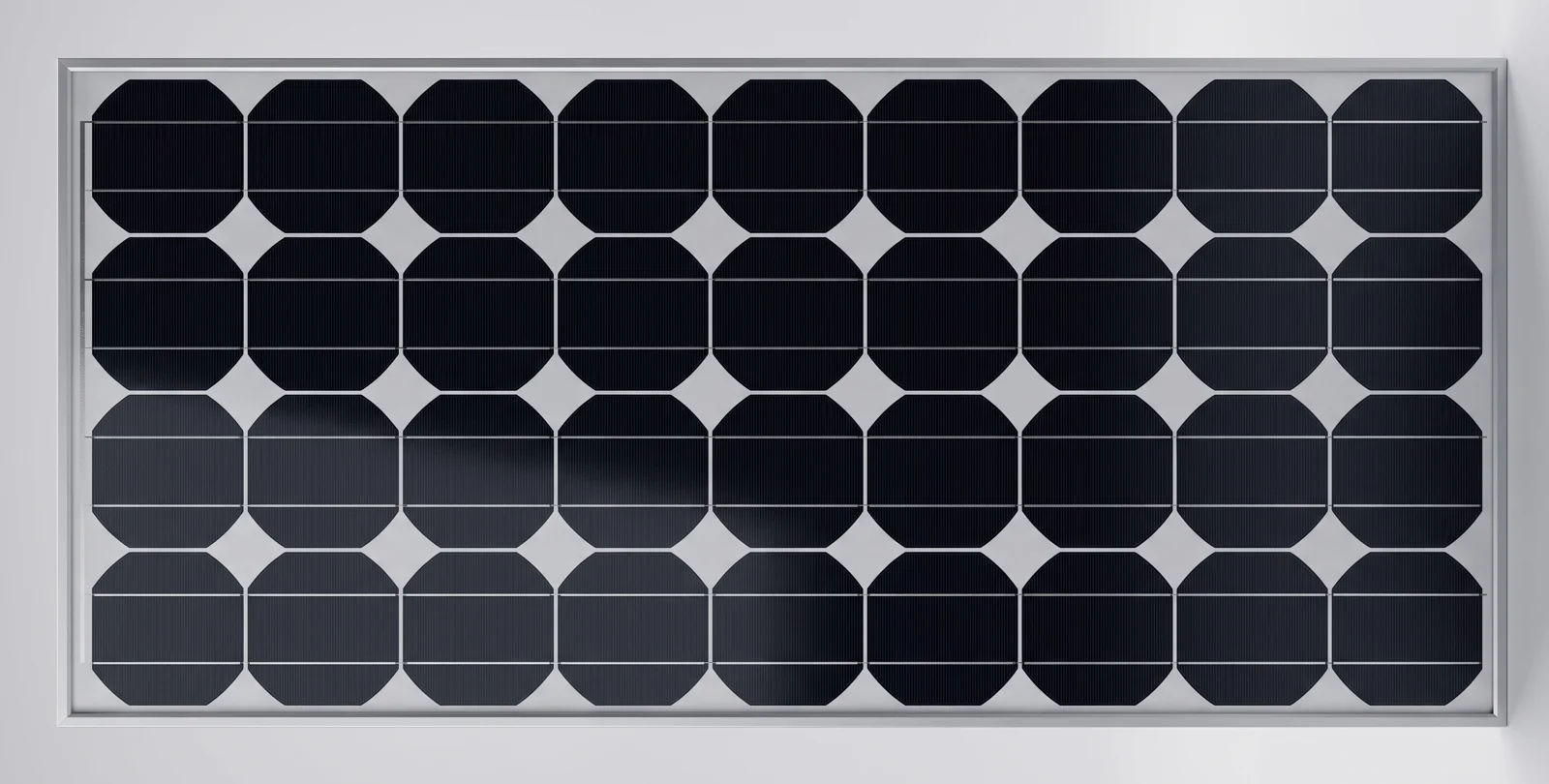
Siemens SP75 / SP70 solar module: datasheet and specifications
75 Wrated power
17 VVmp
21.7 VVoc
7.6 kgweight
1200 × 527 mmoutline
Siemens SP75 / SP70: product photograph restored from the original low-resolution picture.
The SP75 and SP70 are 75 W and 70 W modules of 36 cells on a 1200 × 527 mm frame, 7.6 kg, in 12 V and 6 V versions. The same Yachting World test that praised the SP36 gave the SP75 a ‘Highly Commended’ mark. Read the datasheet footnote on the 6 V version: if it is used in a high-voltage array configuration, custom large bypass diodes with heat sinks must be fitted around every 6 V parallel string.
Electrical data
36 cells in series; silicon (sp series).
Parameter
SP75 (12 V)
SP75 (6 V)
SP70 (12 V)
SP70 (6 V)
Rated power Pmax (W)
75
75
70
70
Minimum power Pmin (W)
70
70
65
65
Current at Pmax, Imp (A)
4.4
8.8
4.25
8.5
Voltage at Pmax, Vmp (V)
17
8.5
16.5
8.25
Short-circuit current, Isc (A)
4.8
9.6
4.7
9.4
Open-circuit voltage, Voc (V)
21.7
10.9
21.4
10.7
Derived figures
Quantity
Value
How it was obtained
Outer area
0.632 m²
calculated from length × width
Power per area
119 W/m²
calculated; Pmax ÷ area at STC
Module efficiency
11.9 %
calculated on outer dimensions (cell efficiency is higher)
Power per weight
9.9 W/kg
calculated
Voc at −20 °C (SP75 (12 V))
25.2 V
calculated with the datasheet Voc coefficient
Voc at −20 °C (SP75 (6 V))
12.6 V
calculated with the datasheet Voc coefficient
Vmp with 60 °C cells (SP75 (12 V))
14.2 to 14.9 V
approximate range; see the note below the table
Rough daily energy
281 Wh
calculated: Pmax × 5 peak-sun-hours × 0.75 system efficiency; a planning figure, not a measurement
With 36 cells in series the Vmp is 17 V at 25 °C. With 60 °C cells it falls to about 14.2 to 14.9 V (the datasheet gives no Vmp coefficient: the lower figure assumes a typical −0.47 %/K, the upper scales the Voc coefficient), a margin of -0.2 to +0.5 V against 14.4 V. The margin is negative or marginal, so on hot days this module may not finish charging a lead-acid battery. In 5 peak-sun-hours the 12 V version adds roughly 16.5 Ah a day to a 12 V battery (Imp × 5 h × 0.75).
Full datasheet tables
Thermal
Parameter
Unit
Value
Nominal operating cell temperature (NOC)
°C
45
Change of Isc with temperature
+2.06 mA/°C (+0.04 %/K)
Change of Voc with temperature
-0.077 V/°C (−0.34 %/K)
Qualification tests
Parameter
Unit
Value
Temperature cycling range
°C
−40 to +85
Humidity, freeze, damp heat condition
% RH
85
Maximum system voltage
V
1000 per ISPRA (EC), 600 per UL 1703
Wind loading or surface pressure
N/m² (PSF)
2400 (50)
Maximum distortion (4)
degrees
1.2
Hailstone impact withstand (diameter @ velocity)
mm @ m/s (in @ mph)
25 @ 23 (1.0 @ 52)
Physical
Parameter
Unit
Value
Number of series cells
count
36
Length
mm (in)
1200 (47.3)
Width
mm (in)
527 (20.8)
Depth
mm (in)
34 (1.3)
Weight
kg (lb)
7.6 (16.7)
Warranty (5)
Parameter
Unit
Value
Power ≥ 90 % of minimum power
years
10
Power ≥ 80 % of minimum power
years
25
Notes from the datasheet. (1) Electrical values at standard test conditions: irradiance 1000 W/m², cell temperature 25 °C, spectrum per ASTM E892 (air mass 1.5). (2) Nominal operating conditions: 800 W/m², ambient 20 °C, wind 1 m/s. (3) Qualification tests per CEC 503. (4) Diagonal lifting of a module corner with three corners fixed. (5) Warranty applies to the original consumer purchaser; see the full limited warranty for conditions. The tier percentages refer to the minimum power rating (Pmin), not the rated power.
Where Siemens recommended it
The Siemens application pages list this module for: telecom, gas and oil, water delivery, traffic and railroad. See the case files for installations from those categories.