
Siemens Solar in telecom: six installations
Six telecom installations from Siemens’ own notes, from a 4,200 m Andes repeater to Mexico’s rural network, with component lists and our arithmetic.
Key takeaways
- The El Negrito repeater in Argentina ran 800 W continuously from 188 modules and a 4,000 Ah, 48 V battery at 4,200 m and −20 °C.
- Only that note states a load: its 192 kWh bank holds about ten days of the 19.2 kWh daily consumption.
- Mexico’s CONDUMEX network installed over 8,500 rural telephones and over 700 repeaters on solar power since 1989.
- The notes do not name the battery chemistry or state a sizing rule.
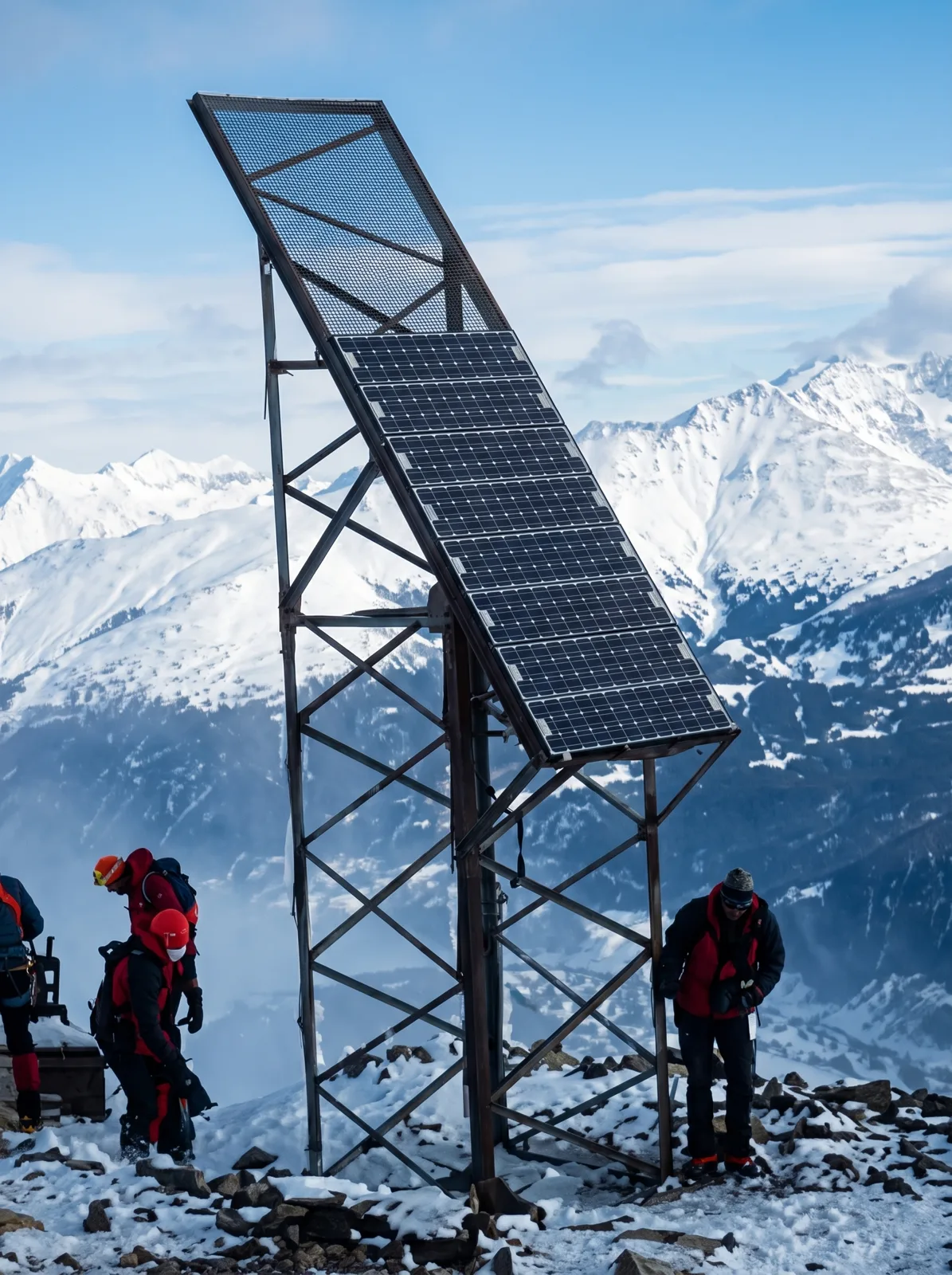
A repeater on a mountaintop needs a few hundred watts, no fuel deliveries and no power line, which is the case Siemens’ telecom page makes for solar. The Siemens Solar telecom page lists the modules it recommended (SM6, SM10, SM50, SM55, SP18, SP36 and SP65/70/75) and links six installation notes. Here they are with the component lists as published and a few calculations of our own.
El Negrito repeater station, Tucumán, Argentina
| Operator | Telecom Argentina |
|---|---|
| Site | 4,200 m above sea level, about 140 km from San Miguel de Tucumán; equipment carried in by pack animals |
| Climate | −20 °C, wind up to 120 km/h |
| Purpose | Connects more than ten communities of the Calchaquíes valley and carries traffic between Salta and Tucumán provinces |
System components as published:
- 188 Siemens M75 solar modules, 48 W each
- 48 V system with 4,000 Ah of battery
- 3 Solartec controllers
- Diesel generators as backup in prolonged bad weather
- Load: 800 W constant; array stated as 8,400 W peak
Our arithmetic:
- 188 × 48 W = 9,024 W. The note’s 8,400 W is 7 % lower; the note does not say why.
- 800 W continuous is 19.2 kWh per day. At 5 peak-sun-hours and 0.75 system efficiency the 8.4 kW array yields about 31.5 kWh, 1.6 times the load. At 3 peak-sun-hours it yields 18.9 kWh, about equal to the load. The note gives the diesel as backup for prolonged bad weather; the thin margin at low sun is consistent with that, but the note does not state the sun-hours.
- 4,000 Ah at 48 V is 192 kWh nominal: ten days of load at total discharge, or about five days if the lead-acid bank is limited to 50 %.
Emergency mobile communications and lighting, Los Angeles earthquake, summer 1991
| Installed by | Barrett Manufacture |
|---|---|
| Use | Trailer-mounted solar generator for police and fire departments, hazardous-materials spills and burn sites |
| Approval | Components UL approved; passed the City of Los Angeles Electrical Equipment Testing Program |
System components as published:
- 4 × M75 modules
- 8 × 220 Ah batteries
- 8 × 30 W DC fluorescent floodlights
- 1 × 12 V, 700 W inverter
Our arithmetic:
- Four 48 W modules give about 192 W at peak. The eight floodlights alone draw 240 W, so the lighting must draw on the batteries; the array can only top them up.
Rural radio-telephony, Mexico
| Installed by | Division de Energías Alternas, CONDUMEX |
|---|---|
| Scale | Over 8,500 rural telephones and over 700 repeaters installed since 1989 |
System components as published:
- Cellular repeater stations: 12 to 20 M75 modules with 1,200 to 2,000 Ah of batteries
- Subscriber systems: 3 to 5 M75 modules with 200 to 500 Ah
Our arithmetic:
- At 48 W per module the repeaters use roughly 580 to 960 W of array and the subscriber stations 145 to 240 W. The note says PV was chosen for all radio and repeater stations because it was the most economical and fastest to deploy.
Rural communications plan, Nepal
| Operators | Nepal Telecommunications Corporation; Siemens Showa Solar Pte Ltd.; Innovative Enterprises |
|---|---|
| Scale | Service to 1,000 ‘ilakas’ (service areas) via MARTS and VSAT systems |
System components as published:
- M55 modules from 250 to 800 peak watts per site
- Siemens Showa Solar SPS-series regulators controlling battery charging and load supply
Our arithmetic:
- At 55 W each, 250 to 800 W is about 5 to 15 modules per site.
Two installations described only briefly in Siemens’ notes
- North America’s first solar-powered digital telephone switch, installed by GTE near San Bernardino, California, using a Siemens Stromberg-Carlson MLC 24-line digital loop carrier. The note gives no module count.
- An amateur-radio repeater on Sulfur Mountain, Southern California. After the 1994 Northridge earthquakes drained backup power, operators connected solar modules from their personal emergency systems to keep a two-metre repeater available to emergency agencies. Siemens Solar and the Sulfur Mountain Repeater Association then configured a permanent independent system for the inaccessible, fire-prone site.
What the telecom notes show
Where the notes give details, the systems are stand-alone layouts (see the system diagrams): modules, a regulator, a battery bank and, at El Negrito, a diesel backup. Only El Negrito states a load, so it is the only note where the sizing can be checked: its 192 kWh nominal bank holds about ten days of the 19.2 kWh daily load. The notes do not state a sizing rule and do not name the battery chemistry. These sums describe how the systems were built; they are not a design basis for a rebuild.
Questions readers ask
What modules did Siemens recommend for telecom?
Its telecom page lists the SM6, SM10, SM50, SM55, SP18, SP36 and SP65/70/75.
How big was the Argentine repeater array?
188 M75 modules of 48 W each: 9,024 W by multiplication, against the 8,400 W the note states.
Was every telecom system battery-based?
Where the notes give details, yes: modules, a regulator, a battery bank, and a diesel backup at El Negrito.
Related guides
Siemens Solar for gas wells and water pumping: installations
Siemens Solar installations for gas-well telemetry in Texas, 330 water pumping stations in the Sahel and Amazon drinking water, with component lists.
Read more →Batteries for a 12 V Siemens solar system
Which battery to pair with Siemens modules: lead-acid versus LiFePO4, how to size from the daily load, worked examples and what the installation notes recorded.
Read more →Typical Siemens solar system diagrams
Block diagrams of four PV system types from Siemens Solar’s original system page: directly connected, stand-alone, generator hybrid and grid-interactive.
Read more →The calculator uses the same arithmetic as the case files.