
Siemens Solar in RVs and boats: installations and kits
A Wyoming pickup camper, a 20-day Pacific crossing on one 42 W module and the RV Power Kits Siemens sold: component lists and what the numbers imply.
Key takeaways
- The Startruck camper recorded 5 A of charging in late October in Michigan and 7 A at midday in Wyoming in November.
- A single 42 W module, two 100 Ah batteries and an 8 A controller powered a 20-day Pacific crossing; the generator ran only three hours.
- The RV Power Kits (36, 50, 75 and 100 W) came with a 20 A controller; the July 1999 release also announced over 350 PowerPro dealers.
Siemens Solar sold packaged RV Power Kits in 36, 50, 75 and 100 W versions, plus expansion kits, which it announced in July 1999, and a line of marine kits shipped to West Marine in June 2000. The sources also keeps two installation notes that show what owners did with them.
The Startruck, Jackson Hole, Wyoming
| Vehicle | Ford F250 Supercab 4×4 with a pop-up pickup camper, built for fishing and hunting trips |
|---|---|
| Designer | Jim Elder |
| Climate | All conditions |
System components as published:
- 2 × ProCharger 4 JF solar modules
- 1 × 12 A charge controller
- 2 × 290 Ah batteries plus a 130 Ah backup and trolling-motor battery
- 8 × 30 W DC fluorescent lights, 12 V refrigerator, water pump, 1,500 W furnace, 13-inch TV/VCR, 700 W microwave, sound system, cellular phone, computer and printer
- 1 × 12 V, 2,000 W inverter
Our arithmetic:
- The note records 5 A into the battery bank in late October on Michigan’s Upper Peninsula with the modules flat, and 7 A at midday in northern Wyoming in November. At about 14 V that is 70 W and 98 W of charging power.
- Two 290 Ah batteries hold about 580 Ah × 12 V = 7 kWh nominal. At the 98 W midday peak, and roughly two to three full-sun-equivalent hours on a short autumn day, the two modules add about 200 to 300 Wh: enough for a few hours of lighting and the refrigerator, but not the microwave or furnace, which must run from the batteries.
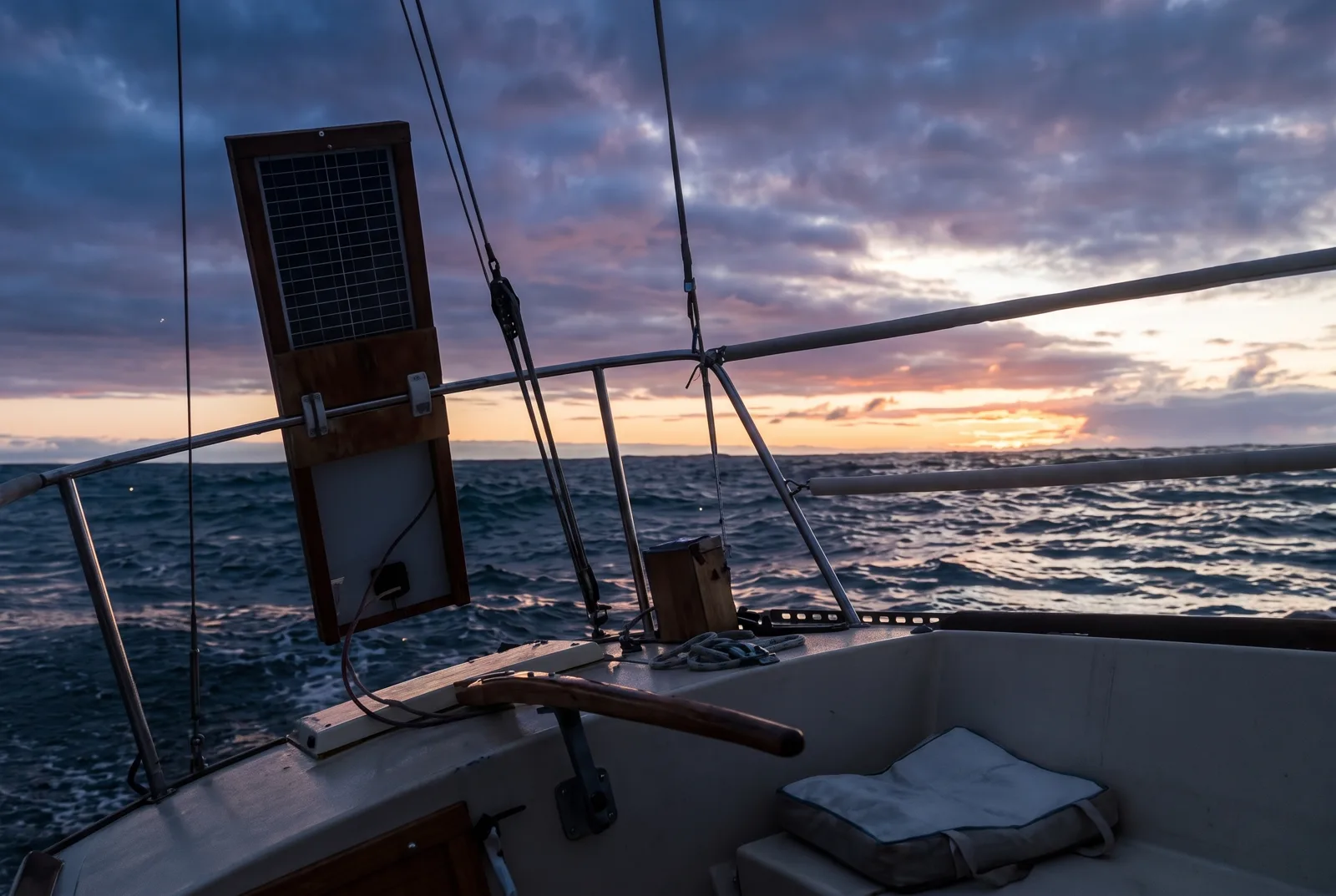
The Oa Oa: Golden Gate to Lahaina, Maui
| Installed by | David Thoma, Ventura, California |
|---|---|
| Vessel | 30 ft sailboat |
| Passage | 20 days |
System components as published:
- 1 × M65 module, 42 W
- 2 × 100 Ah marine batteries
- 1 × 8 A charge controller
- 1 × 350 W gasoline generator
Our arithmetic:
- The loads were navigation and communications gear, mast-head and compass lights, wind instruments, autopilot and a stereo. At 42 W × about 5 peak-sun-hours × 0.75 the module delivers about 160 Wh a day, or 13 Ah at 12 V.
- That is a small load by modern standards, and the note says it was enough: only three hours of generator running over the whole crossing, despite two severe weather fronts.
What the kits promised
The RV Power Kit was a complete package intended for quick installation, from trickle-charging batteries to powering appliances, and modular so that panels could be added. The kit table lists panel dimensions of 25 × 21 in for the 36 W kit, 31 × 23 in for the 50 W kit, 48 × 21 in for the 75 W kit and 59 × 24 in for the 100 W kit. Those match the outlines of the SP36, SR50, SP75 and SR100 datasheets, but the source does not name the modules inside the kits. Each kit included a 20 A charge controller, and the 100 W kit was rated at 5.6 A. The July 1999 release also announced more than 350 Authorized PowerPro dealers in North America.
The Yachting World ‘Great Atlantic Gear Test’ mentioned on the SP36 and SP75 pages was run over about 5,000 miles of ocean sailing and tested the modules themselves, not the kits.
If you are replacing a kit module today, the calculator shows the controller current and the charging headroom for a 12 V battery.
Questions readers ask
How much energy does one 42 W module give at sea?
About 160 Wh a day by our estimate (42 W × 5 h × 0.75), roughly 13 Ah at 12 V.
Did the kits contain SP modules?
The kit table lists panel sizes that match the SP36, SR50, SP75 and SR100 outlines, but the source does not name the modules.
What controller did the camper use?
A 12 A controller; the source does not state its type.
Related guides
Charge controllers for Siemens solar modules
How to choose a charge controller for Siemens modules: PWM or MPPT, why 36 cells suit 12 V batteries, cold-weather Voc limits and how to size the current.
Read more →Batteries for a 12 V Siemens solar system
Which battery to pair with Siemens modules: lead-acid versus LiFePO4, how to size from the daily load, worked examples and what the installation notes recorded.
Read more →Siemens SP75 / SP70 solar module: datasheet and specifications
Siemens SP75 / SP70 (36 cells, 1200 × 527 mm, 7.6 kg): Pmax 75 W, Vmp 17 V, Voc 21.7 V. Datasheet and calculated cold-weather Voc.
Read more →The calculator uses the same arithmetic as the case files.