
Siemens Solar homes: off-grid houses and Germany's 1,000 Roofs
Siemens-supplied homes from Palau and the California coast to Germany’s 1,000 Roofs and 100 Sacramento rooftops, with the numbers checked.
Key takeaways
- A 1,320 Wp array of 24 M55 modules powered a home on Palau, 26 miles from the nearest utility line.
- Germany’s 1,000 Roofs programme: 1,177 systems and 2,900 kWp by 25 June 1993, an average of 2.46 kWp, with Siemens supplying over half the modules.
- The Sacramento ‘PV Pioneers’: 100 systems of 4.4 kWp, 84 modules each, designed for about 7,000 kWh a year.
- The Earthsafe kits (300 to 2,400 W) were announced in August 1999.
Siemens’ residential notes cover two very different worlds: remote homes that are the utility, and grid-connected rooftops that earned a subsidy or a credit. The August 1999 release introduced Earthsafe pre-engineered kits for homes, configured for 300, 600, 900, 1,500 or 2,400 W; the residential page lists an ‘Earthsafe 20’ range of 600 to 2,400 W. The release index says Earthsafe 10 systems received UL listing in June 2000.
Remote home and community centre, Koror, Palau
| Installed by | Inter-Island Solar Supply |
|---|---|
| Climate | Tropical, humid, hot |
| Distance to the grid | 26 miles from the nearest utility line |
System components as published:
- 24 × M55 modules (1,320 Wp)
- 12 × 700 Ah IBE batteries
- Custom control enclosure with DC load centre
- 1 × Trace 2624-SB inverter
- 3 × SGM 8 mounts
- 8 × 24 V DC 40 W lights
Our arithmetic:
- 24 × 55 W = 1,320 W, exactly the stated array. At 5 peak-sun-hours and 0.75 efficiency it yields about 5 kWh a day.
- The 2624-SB is a 24 V inverter. If the 12 batteries are 2 V cells in series, the bank is 700 Ah at 24 V, about 16.8 kWh nominal: three days of the array’s output.
A ‘dream home’ built for solar power, California central coast
| Installed by | John Ewan, Pacific Energy Company |
|---|---|
| Loads | Two large built-in refrigerators, two freezers, a photographic darkroom, a swimming pool and a full set of household appliances |
System components as published:
- Main house: 3.6 kW from M75 modules in three arrays
- Deep-well pumping: 636 W array
- Swimming-pool filter: 576 W array
- Water well and storage: 12 M55 modules
- Active dual-axis sun trackers on all arrays
- Propane generator backup
Our arithmetic:
- 3.6 kW of 48 W modules is about 75 modules. The two pump arrays are 636 W and 576 W; if those are 53 W and 48 W modules, that is 12 modules each.
The note stresses expandability: the first two arrays were installed to power construction, the others added as building progressed, and the pool was added later.
Colonial-era farmhouse, California
| Share of demand | Modules supply about 80 % of the electricity for the house, a separate caretaker’s quarters and a nearby ostrich farm |
|---|
System components as published:
- 32 V system: 2 kW array, modules series-connected in strings of two
- Storage in 2 V lead-calcium cells
- 3 kW inverters in cascade
- Diesel generator for supplementary power
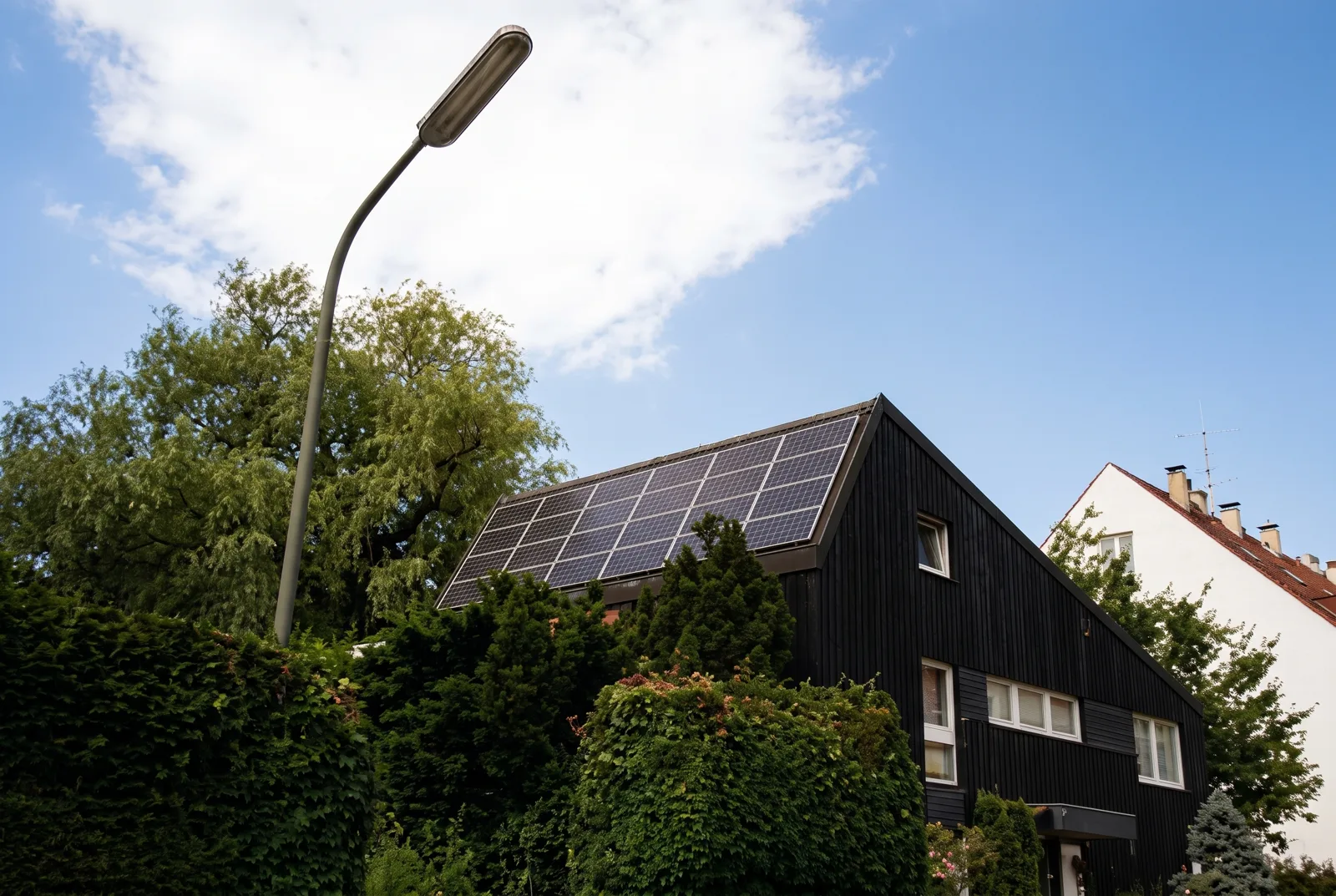
Germany’s ‘1,000 Roofs’ programme
| Subsidy | 70 % direct (50 % federal, 20 % state) |
|---|---|
| Target | 2,250 mainly residential grid-connected systems of 1 to 5 kWp |
| Progress at 25 June 1993 | 1,177 systems, 2,900 kWp, average 2.5 kWp |
| Siemens’ role | Supplied more than half of the modules installed, plus inverters |
Our arithmetic:
- 2,900 kWp ÷ 1,177 systems = 2.46 kWp per system, matching the stated 2.5 kWp average.
The note calls the programme very well documented and describes its lessons as valuable for future US rooftop projects. Its successor, the 100,000 Roofs programme, was presented around the 1998 German election and starts in 1999; the sources’ accounts differ on who announced it and when, see the history page.
PV Pioneers, Sacramento
| Customer | Sacramento Municipal Utility District (SMUD) |
|---|---|
| Contractor | S.L. Henry Services |
| Scale | 100 roof-mounted, grid-connected systems of 4.4 kWp |
| Terms | Hosts volunteered and paid a 15 % surcharge for the electricity generated |
System components as published:
- 84 M55VJ modules per system, in 12 panels of 7 modules
- 4 kW Omnion inverter per system
- Array circuit: 42 modules in series by 2 in parallel
- ‘Roofjack’ galvanised steel mounts on composition roofs
Our arithmetic:
- 84 × 53 W = 4,452 W, the stated 4.4 kWp. 42 × 2 = 84 modules, so the circuit is consistent.
- Design output 7,000 kWh a year per system is about 1,590 kWh per kWp (calculated); the source gives no regional comparison.
Questions readers ask
What was the 1,000 Roofs programme?
A German programme with a 70 % direct subsidy (50 % federal, 20 % state) for 2,250 mainly residential grid-connected systems of 1 to 5 kWp.
Were any of these homes off the grid?
Yes: the Palau home, the California coast house and the farmhouse were remote; the German and Sacramento systems were grid-connected.
What are Earthsafe kits?
Pre-engineered home solar kits configured for 300, 600, 900, 1,500 or 2,400 W, with installed prices starting at $3,395 for 300 W in 1999.
Related guides
Typical Siemens solar system diagrams
Block diagrams of four PV system types from Siemens Solar’s original system page: directly connected, stand-alone, generator hybrid and grid-interactive.
Read more →Siemens Solar utility and building systems: seven plants
Seven utility and building installations: Munich’s 1,016 kW trade-fair roof, PVUSA Kerman, PHALK 500 and more, with arithmetic checks.
Read more →Batteries for a 12 V Siemens solar system
Which battery to pair with Siemens modules: lead-acid versus LiFePO4, how to size from the daily load, worked examples and what the installation notes recorded.
Read more →The calculator uses the same arithmetic as the case files.