
Siemens Solar utility and building systems: seven plants
Seven utility and building installations, from a 330 W switch controller to Munich’s 1,016 kW trade-fair roof, with arithmetic checks.
Key takeaways
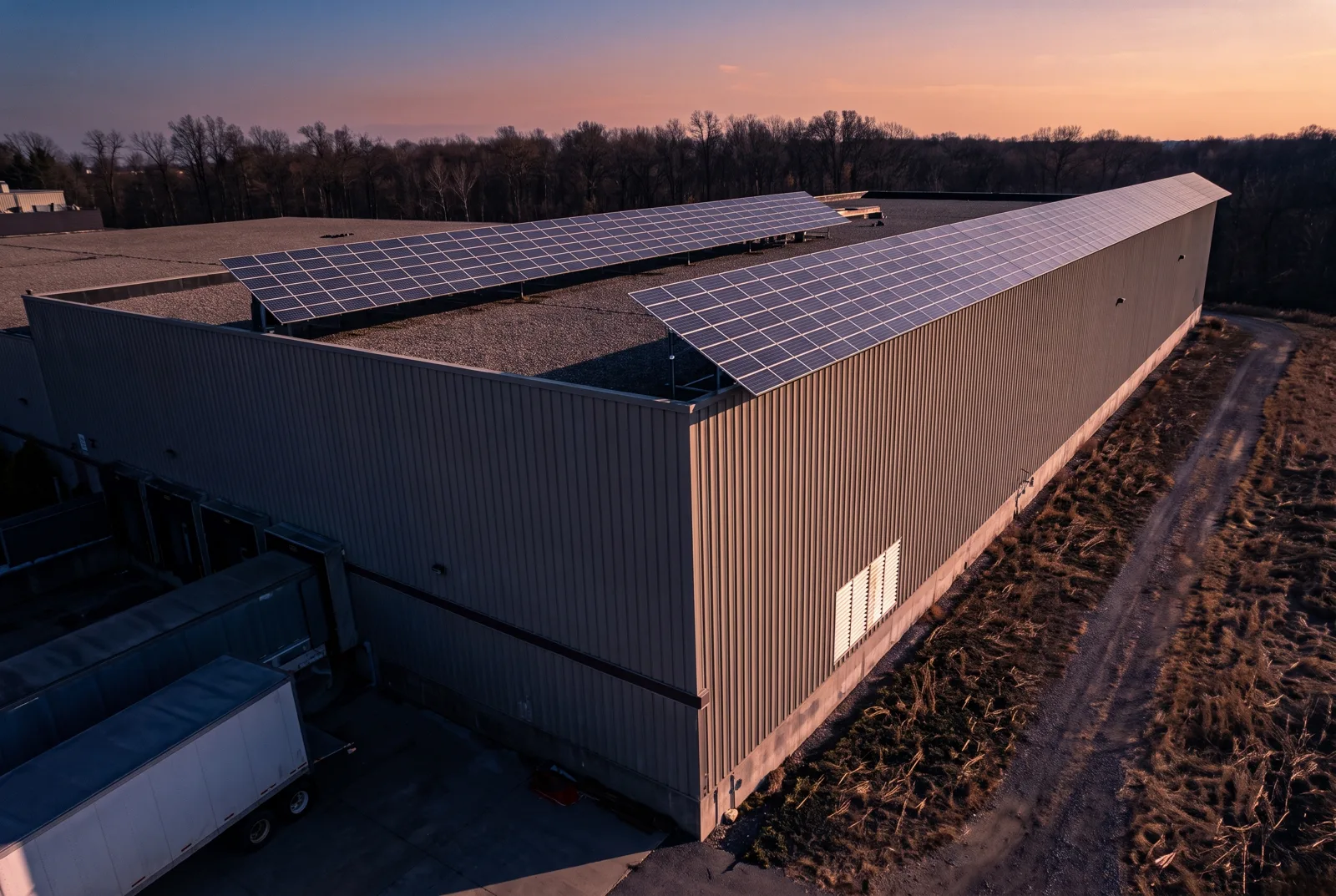
- Munich’s trade-fair roof: 7,812 frameless 130 W modules, 1,016 kW, designed for 1,000,000 kWh a year (about 984 kWh per kWp).
- The Kerman fact sheet lists 1,224 panels of ten 55 W laminates (673 kW) against the stated 650 kW, which matches 53 W per module.
- The Sacramento Hedge array circuit (24 in series by 400 in parallel) would be 9,600 modules, twice the stated 4,800.
- At the small end, six M55 modules and a 24 V, 200 Ah battery operated two 115 kV switches in Georgia.
At the large end are the utility and building systems. They show how the same silicon technology was scaled: from 6 modules operating a 115 kV switch to 12,240 modules at Kerman. Where the notes allow it, we check the stated figures against the component lists.
New Munich Trade Fair Centre, Germany
| Customer | Solardach München Riem GmbH |
|---|---|
| General contractor | Siemens Solar GmbH |
| System | Fixed roof mount, grid-tied; six halls of 11,000 m² each |
| Planning | Bayernwerk, under the DM 100 million programme ‘Bavaria and Future Energy’ |
System components as published:
- 7,812 frameless 130 W modules with 84 mono-crystalline cells each (SM130-L)
- 3 × 330 kVA inverters in master-slave-slave mode
- 4,000 VAC feed into a 20,000 V transformer
- South-facing at 28° tilt
- Array: 21 modules in series by 372 in parallel (340 to 420 VDC)
- Design output 1,000,000 kWh a year, 4 % of the centre’s needs and over 50 % when no events are on
Our arithmetic:
- 21 × 372 = 7,812 modules ✓. 7,812 × 130 W = 1,015.6 kW ✓ (stated 1,016 kW).
- 7,750 m² of array for 1,016 kW is 131 W/m², close to the 129 W/m² we calculate for the SM55.
- 1,000,000 kWh ÷ 1,016 kWp is about 984 kWh per kWp (calculated).
- The note equates one million kWh with the average demand of 340 German households, or about 2,900 kWh each.
The note calls this the world’s largest rooftop PV plant at the time.
Battle Creek Environmental Magnet School, St. Paul, Minnesota
| Supplied by | SunWize Energy Systems |
|---|---|
| System | 12 kW grid-connected roof array, 300 V, expected output over 15,000 kWh a year |
| Funding | Minnesota legislature, 1993; monitoring equipment donated by Northern States Power |
System components as published:
- 234 × M55 modules pre-mounted on Unistrut racks (36 × Unistrut P4000 racks)
- 9 × PV source circuit protectors
- 3 × 4 kW Omnion inverters
Our arithmetic:
- 234 × 55 W = 12.9 kW against the stated 12 kW, so the rating used is about 51 W per module. 15,000 kWh ÷ 12 kW is about 1,250 kWh per kWp (calculated).
The array is suspended over a roof that was designed only for snow loads, which is why it was prebuilt on racks.
PVUSA US-2, Kerman, California
| Customer | PVUSA (PG&E, DOE, EPRI, CEC and others) |
|---|---|
| Contractor | Bechtel Construction; Siemens Solar Industries awarded the contract in April 1992 |
| Timeline | Construction began September 1992, finished March 1993 |
| System | 500 kWac horizontal north-south single-axis tracking array, about four acres |
System components as published:
- 12,240 × M55VJ mono-crystalline modules on eight tracker rows
- 650 kW peak DC
- Two Omnion three-phase inverters to 12.5 kV, tied to PG&E Kerman feeder 1104
Our arithmetic:
- 12,240 × 53 W = 649 kW, close to the stated 650 kW. But the fact sheet also lists 1,224 panels of ten 55 W laminates (550 W each), which would be 673 kW: the 650 kW figure matches 53 W per module, not 55 W.
- The sheet gives 502 kWac at PVUSA test conditions from two 275 kVA Omnion inverters, a DC to AC ratio of 650 ÷ 502 = 1.29.
- Array circuit 144 modules in series by 85 in parallel = 12,240 ✓. Design output 1,200,000 kWh a year, about 1,850 kWh per kWp (calculated: 1,200,000 ÷ 650).
The plant was built to demonstrate PV grid support: relieving overloaded summer-peaking distribution feeders.
Sacramento Municipal Utility District, Hedge Substation
| System | 1-axis tracking, grid-tied, 254 kW peak DC, 20 trackers of 20 panels |
|---|---|
| Contractor | UPG |
| Inverter | 200 kW Omnion, 12.47 kV three-phase intertie |
| Design output | 440,000 kWh a year |
System components as published:
- 400 panels of twelve 53 W modules = 4,800 modules
- Array circuit as published: 24 modules in series by 400 in parallel
Our arithmetic:
- 400 × 12 × 53 W = 254.4 kW ✓. But 24 in series × 400 in parallel would be 9,600 modules, twice the stated 4,800; the note is internally inconsistent. 24 × 200 = 4,800 would fit.
- 440,000 kWh ÷ 254 kW is about 1,730 kWh per kWp (calculated; this is a single-axis tracking array).
PHALK 500, Mont-Soleil, Switzerland
| Consortium | Electric utilities led by Electrowatt |
|---|---|
| Siemens Solar’s part | 560 kW of frameless modules plus engineering input on integrated panels |
| System | Fixed 45° tilt, about five acres, on a gently sloping hill facing slightly east of south |
System components as published:
- 1,320 panels of eight 53 W laminates, panels bonded in a temporary facility near the site
- One ABB inverter into the 16 kV network
Our arithmetic:
- 1,320 × 8 × 53 W = 559.7 kW ✓ (stated 560 kW), panel power 424 W. 4,575 m² for 560 kW is 122 W/m².
- Array circuit 48 modules in series by 220 in parallel = 10,560 ✓. Design output 700,000 kWh a year, about 1,250 kWh per kWp (calculated). Inverter: one 500 kVA ABB, 16 kV, 50 Hz.
The structures are laid out irregularly on the hillside for a more natural look than rigid rows.
X-Calak, Quintana Roo, Mexico: village hybrid power
| Installed by | CONDUMEX |
|---|---|
| Loads | 80 homes, 4 restaurants and a 20-room hotel |
| Climate | Tropical, high humidity |
System components as published:
- 6 × 10 kW wind turbines
- 234 × M75 modules (11.2 kW)
- 216 × 1,640 Ah batteries (as written in the note)
- 1 × 40 kW three-phase inverter
- PV/wind supervisory and control system
- Existing 125 kW diesel generators
Our arithmetic:
- 11.2 kW ÷ 234 modules = 47.9 W per module, matching the 48 W quoted for the M75 in the Argentine note.
- Read literally, 216 batteries of 1,640 Ah would be about 354,000 Ah, far too much for an 11.2 kW array. We read it as 216 two-volt cells in series (a 432 V bank of 1,640 Ah, about 708 kWh), which is our interpretation, not the note’s wording.
The note credits the hybrid system with helping stem migration to cities and supporting the tourist and fishing industries.
Solar-powered motor operators on 115 kV switches, Marietta, Georgia
| Utility | Georgia Power |
|---|---|
| Purpose | Remote sectionalising of important loads; two 115 kV switches motorised with 24 V operators |
System components as published:
- 6 × M55 modules (300 W array)
- 24 V, 200 Ah battery bank
- 2 × 24 V motor operators
- 1 remote terminal unit and a radio link
Our arithmetic:
- 6 × 55 W = 330 W, against the stated 300 W. 24 V × 200 Ah is 4.8 kWh nominal for a load that only operates a motor occasionally.
Distribution lines are not always available, so AC transformers to motorise remote switches are in many cases impractical; solar avoids sending crews to the field.
Scale in one table
| System | Peak DC power | Modules | Stated yearly energy | Calculated kWh/kWp |
|---|---|---|---|---|
| Georgia Power switch | 0.3 kW | 6 | n/a | n/a |
| Battle Creek school | 12 kW | 234 | 15,000 kWh | 1,250 |
| Sacramento Hedge (tracking) | 254 kW | 4,800 | 440,000 kWh | 1,730 |
| PHALK 500 | 560 kW | 10,560 | 700,000 kWh | 1,250 |
| PVUSA Kerman (tracking) | 650 kW | 12,240 | 1,200,000 kWh | 1,850 |
| Munich Trade Fair | 1,016 kW | 7,812 | 1,000,000 kWh | 984 |
Questions readers ask
Which was the largest system?
Munich at 1,016 kW peak. Kerman, California had the most modules (12,240).
Why do some figures not add up?
Component lists in the notes are sometimes inconsistent with stated totals; we flag each case rather than correct the source.
What do the kWh per kWp numbers mean?
They divide the stated design energy by the stated array rating; they are calculated by us, not measured.
Related guides
Typical Siemens solar system diagrams
Block diagrams of four PV system types from Siemens Solar’s original system page: directly connected, stand-alone, generator hybrid and grid-interactive.
Read more →Siemens Solar history, 1997 to 2000: a timeline from the company’s own press releases
A dated timeline of Siemens Solar from its own press releases: CIS thin-film modules, efficiency records, 100,000 Roofs, RV and Earthsafe kits.
Read more →Siemens Solar case files: how the modules were used
Index of 25 Siemens Solar installation notes in six groups: telecom, gas and water, RV and marine, homes, utility and street lighting.
Read more →The calculator uses the same arithmetic as the case files.